Showing posts with label healthcare. Show all posts

Wednesday, July 19, 2017

NBC News/WSJ Poll: Just 12% in Key Trump Counties Back GOP Health Care Effort

Trump voters hate Trumpcare
#bettersimplercheaper #healthcareforall #singlepayer

NBC News/WSJ Poll: Just 12% in Key Trump Counties Back GOP Health Care Effort


Just 12 percent of Americans living in the counties that fueled Donald Trump's win in the 2016 presidential election support the Republican Party's efforts on health care, according to results from the NBC News/Wall Street Journal poll of these "Trump counties."
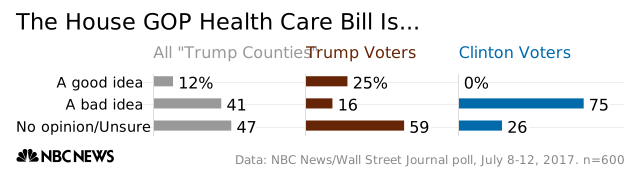
Asked their views on the health care legislation passed by the House of Representatives in May and backed by President Trump, 12 percent of the respondents in these counties — consisting of Republicans, Democrats and independents — called the bill a good idea, while 41 percent said it was a bad idea. Forty-seven percent had no opinion or say they’re not sure.
Even among Trump voters in these counties, only 25 percent believe the House GOP health care bill is a good idea, 16 percent think it’s a bad idea and 59 percent have no opinion or are unsure.
That’s compared with 75 percent of Hillary Clinton voters in these counties, who say the legislation is a bad idea, zero percent who say it’s a good idea and 26 percent who have no opinion or are unsure.
Last month’s national NBC/WSJ poll found that 16 percent of all Americans called the House bill a good idea, versus 48 percent who see it as a bad idea.
“It was kind of like they were walking a plank that they knew they were going to fall off from,” Democratic pollster Fred Yang said of Republican lawmakers who voted for this legislation. Yang and his firm Hart Research Associates conducted this NBC/WSJ poll with the GOP polling firm Public Opinion Strategies.
Senate Republican efforts to repeal and replace the Affordable Care Act collapsed Monday night, while another plan — a simple repeal of Obamacare with no replacement — was effectively killed Tuesday when three senators came out against it.
This NBC/WSJ poll's sample was taken from 439 counties in 16 states — Colorado, Florida, Georgia, Indiana, Iowa, Maine, Michigan, Minnesota, Missouri, Nevada, New Hampshire, North Carolina, Ohio, Pennsylvania, Virginia and Wisconsin — that either flipped from President Barack Obama to Trump, or where Trump greatly outpaced Mitt Romney's performance in 2012.
And there’s little difference in views of the GOP health care effort in these two different kinds of Trump counties.
In the “surge” counties, 13 percent of adults think the House legislation is a good idea.
And in the “flip” counties, just 12 percent think the bill is a good idea.
The rest of this NBC/WSJ poll – which was conducted July 8-12 of 600 adults in these counties, and has an overall margin of error of plus-minus 4.0 percentage points – will be released Wednesday morning.
In "Flip" counties, 342 interviews were conducted, which has a margin of error of plus-minus 5.3 percentage points. And in "Surge" counties, 258 interviews were conducted, and the margin of error there is plus-minus 6.1 percentage points. 


Tuesday, May 9, 2017

Basic facts and premises about health system reform: the how and why of single payer

Basic facts and premises about health system reform: the how and why of single payer
#bettersimplercheaper #healthcareforall #singlepayer

My friend, Lavarr Webb, published a comment about health system reform on his website "Utah Policy" this morning (May 9, 2017). It takes courage to speak up about health care, given that emotions are running high. I admire his willingness to further the public discussion about this issue, which I believe is the most important domestic policy problem the US faces. But I believe he has incorrectly characterized or misunderstood what the problem really is. Here is what he said paragraph by paragraph, followed (in parentheses) by my responses:

. . . the national furor over health reform all across the country, demonstrates how emotional and difficult this issue has become. It’s nearly impossible to stake out a sensible position that attracts widespread support, that responsibly deals with the healthcare crisis, while not requiring massive tax increases or running up the national debt.

(Naturally healthcare is an emotional issue. Few public policies hit closer to home than how or whether patients receive needed care for illness and injury. There is a position on healthcare that numerous polls over many years have shown has widespread support: single payer. And no, single payer health reform is not irresponsible. It will not require massive tax increases or a ballooning national debt. Supporting the status quo, business as usual in American health care, however, is irresponsible. It has always led to massive tax increases and is solely responsible for the growing federal deficit. Both democrats and republicans are and continue to be responsible for the disaster that is American health care, largely because elected officials from both parties have refused to even consider, much less debate and legislate, single payer health system reform.)

In the massive uprising against the healthcare plan just passed by the U.S. House, it’s easy to forget that Obamacare, in many ways, was a disaster. It was so unpopular that it contributed significantly to big Democratic losses in Congress and Republicans winning control over Congress and the presidency.
(There is surprisingly little difference between the American Health Care Act (which I will call Trumpcare)
and the Affordable Care Act (which most call Obamacare). House Republicans actually did not repeal most of Obamacare-6 of 10 titles in the Affordable Care Act were not even touched by the recently passed AHCA legislation. The uproar over Trumpcare is largely symbolic, partisan bickering. Both are bad policy, because both prop up business as usual in American healthcare, especially the private, for-profit health insurance business model. Yes, Obamacare was failing, because health insurance is a failed business model that only ever survived because of massive government subsidies coupled with most favored business treatment in laws and regulations. For the same reasons, Trumpcare is doomed to failure. Ds who are defending Obamacare and Rs who are promoting Trumpcare are both doing a disservice to American patients (meaning all of us at some point in our lives). Bickering between the two parties over health care is partisanship at its worst. There is no meaningful difference between the two parties on health care. In order to achieve real change in our health system the voters will need to throw members of Congress from both parties out of office.)

But Obamacare did bring a lot more people into the system of government benefits. And despite its many flaws, the Obamacare mandate that everyone buy health insurance, and everyone is covered in some fashion, created and strengthened the notion that healthcare access is an absolute right that everyone should enjoy, at a price they can afford, no matter their situation in life.

 (Obamacare mostly brought people into 'coverage' or 'healthcare access' through Medicaid, not the mandate to buy insurance. Tens of millions were still left out in the cold, without coverage, after implementation of Obamacare. Those who managed to get coverage quickly realized that the 'coverage' offered was a useless financial gimmick which did not protect them from financial disaster in the event of injury or illness and cost them more than they could afford anyway. It has become common among advocates to describe 'healthcare access' as a right, but of course that is not literally true. First of all, no one needs 'healthcare access' or health insurance, but everyone needs health care. The rights of Americans are listed in the Constitution, and health care is not among them. However, there is no right to asphalt in the Constitution either. None-the-less, I can drive from my house to the White House without interruption because we Americans have long since figured out that roads, highways, and freeways are infrastructure needed for the 21st century. Likewise, we have generously funded health care for decades because it is infrastructure needed to make pursuit of life, liberty, and happiness possible.)

Once a government benefit has been extended, it’s nearly impossible to withdraw it. Thus, as other commentators have stated, we’ve crossed a critical tipping point in this country. Everyone must have access to full medical benefits. And society (that’s you and me) must pay for it.

 (No better illustration of this point about the impossibility of withdrawing a government benefit exists than the failure of Congress to withdraw the massive employer tax credits supporting the purchase of health benefits for employees after WWII. Offering tax free health insurance was a way for employers to recruit women to work in the factories producing needed war materiel during the war without raising wages and causing inflation. That tax credit is now worth $500 billion each year and is the principle reason why health insurance became the featured health financing business model in the US. When its costs are combined with those of tax funded programs like Medicare, Medicaid, CHIP, public employee health benefits, VA health care, etc, etc, etc, it is easy to see how Americans have come to be taxed at higher levels for health care than any other citizenry. $2 trillion in taxes are spent annually on health care in the US, out of total health care spending each year of $3 trillion. We don't need more tax money to fund American health care, we need to spend the already available public funds more efficiently. But efficiency is not possible with the for-profit health insurance business model, where overhead is routinely more than 25%. In contrast, Medicare overhead is more like 2% to 3%. Single payer health reform is administratively efficient and thus fiscally conservative.)

The trouble is, the only truly effective way to ensure that everyone has full access to healthcare is through a single-payer system. Essentially, put everyone on Medicare. That’s what the Democrats really want. And that may be where we’re headed.

(That's not what the democrats really want. Twice in my lifetime there has been a democrat in the White House and democrats leading both houses of Congress, both times with serious mandates from the electorate to do something about health system reform. Neither Pres. Clinton nor Pres. Obama even mentioned single payer. Single payer advocates were arrested by democrat members of the US Senate when they showed up at Senate Finance Hearings in 2009. Democrats as much as Republicans have acted to prop up the health insurance business model, repeatedly, down to their present defense of Obamacare. But single payer is what the American people want, according to polling from several different sources. And it is the only truly effective way to ensure that everyone has healthcare, and not just access to 'coverage'.)


Republicans want a market-based system. But we’ll never have a true free enterprise system in healthcare as long as employers provide health insurance and as long as insurance pays for most healthcare needs. If insurance provided only catastrophic coverage, and we paid for most procedures out of our own pockets, then free-market incentives would be injected into the system. We’d shop around and pay attention to what various health services cost.

(Both democrats and republicans want a 'market-based health care system' because the biggest source of political donations is the medical industrial complex. Politicians of both parties are paid to have the opinion that market forces will solve our health system problems. Trouble is, health care is not a commodity efficiently distributed through a free market. None of the prerequisites required for market efficiency are true of health care. Patients are not shoppers, or buyers who can beware. Doctors are not (or should not be) sellers who are self-interested. The transaction between 'buyer' and 'seller' in healthcare affects everyone

 (an economic principle called positive externality) and not just when the patient has tuberculosis or some other communicable disease which could infect others. The vast majority of health care dollars are spent in 'catastrophic' situations (trauma, heart attacks, strokes, etc) and most procedures, even common ones like appendectomies, are priced way out of the buying power of middle class Americans. Thus, the idea that catastrophic, individually owned health insurance

 (no employer benefit) will create a market situation is simply bogus. Further, care of chronic conditions, like diabetes, determines the frequency of catastrophic events, like heart attacks and stroke. So leaving every patient to fend for herself in 'shopping' and paying for care is foolishly increasing the rate we will need to use our pooled resources to care for emergencies. Finally, what healthcare actually costs is not at all related to what prices are set by the sellers. Because, unlike a real market commodity, there is no inverse relationship between demand for health care and its price. Nobody buys an appendectomy because it is on sale. And no price is too high for an appendectomy when in fact you have appendicitis. Also unlike a market, high quality care costs less than poor quality care. We have mediocre care in the US: too many clinically inappropriate services, too many patient injuries, and too few hospitals and clinics that consistently deliver care based upon current clinical science. And therefore we have highest costs in the world. Real health system reform begins with acknowledging that health care is not a market commodity and then improves health care quality and makes health care financing efficient.)

Healthcare has not been a free market system for many decades, and probably will never be. We’re not smart healthcare consumers. (Healthcare delivery has never been a free market system and never can be. Beginning with the massive tax credits which propped up the growth of the private for-profit health insurance business model from its very beginning, and on through the Hill-Burton Act which financed hospital construction across the nation, and continuing through the myriad of state, local, and federal health programs of today, everything about our health system that works at all is attributable to public funding. The private sector in health care has profiteered (in windfall style) from healthcare delivery in the US. Warren Buffet calls our medical industrial complex a worm eating away at the inside of the American economy. Indeed, American business is made less internationally competitive by our stupid insistence on employment health benefits. The problem is not that Americans are poor healthcare consumers. People in need of healthcare are patients, not consumers, shoppers, or buyers. Even with the internet, there is no way for a patient to arm him/herself with the clinical judgment necessary to make even simple decisions about their own care. Doctors are trained for a decade in order to prepare to make those decisions for their patients.)
Perhaps the U.S. Senate can cobble together some miracle system that gets everyone covered, despite pre-existing conditions, and does it without busting the budget or massively raising taxes. But I doubt it. (Correct. There will be no miracle from the US Senate. As long as the premise remains that health policy must be market-based, must prop up health insurance, and must be federal, there can be no good legislative outcome. The budget is already busted with the health care status quo. All of the federal debt on into the future is driven by the growing corporate welfare given to the medical industrial complex by politicians from both parties. )

It may take a few years, but we’re probably headed to a single-payer system. And if everyone has coverage for everything, there will be little incentive to be wise healthcare consumers. To make up for this defect, the system will impose its own controls. Healthcare will have to be rationed. Panels of doctors (the infamous death panels) will determine what levels of care are appropriate in what situations – and what prices will be. (This is the dystopian nonsense that has kept anyone from seriously discussing single payer. Look at every country that already has single payer health care. They spend far less than we do, they have better outcomes, and they routinely rate their health care experiences higher than do Americans. None of their citizens are going bankrupt because of illness or injury. They don't fund needed health services with bake sales or gofundme accounts. Single payer allows for setting prices that are truly related to what health goods and services actually cost. As opposed to American health care business as usual, where prices for a drug can rise 1000% overnight. Death panels have always been a scare tactic by the naysayers. What is really scary is that business as usual in American health care leads to the unnecessary death of more than 100,000 patients each year who die of preventable injuries while they are hospitalized. If the safety record of American hospitals were to be superimposed on the airline industry we would have a 747 crash every other week. That is what is truly frightening. Stop with the death panel nonsense.)

As in other countries with single-payer systems, we will see shortages and long waits for procedures. Market incentives to improve service and innovate will not exist.

(We have shortages in the US. Rationing happens in every health care system, but especially in our faux market system. We ration by ability to pay, meaning that for many, many Americans, there is no queu that they can even get into. And for those who can pay, they often receive too much service, also at an enormous cost of life and limb, and money. We Americans have a health care system that would rather make a sale than care for a patient. Here, with perverse market incentives, we allow our patients with pneumonia to become more sick than necessary, because a hospital make more money when a patient hits the ICU.)

But everyone will have some government-determined level of healthcare access and service. Wealthy people, of course, will be able to pay for the best healthcare in the world. (The best healthcare in the world is not possible, even for the most wealthy individual, without a society that pays to make it possible. No one can anticipate what kind of care they might need, or when they might need it. Having all kinds of expensive care always available is out of the reach of even Bill Gates. It is only available in first world economies where resources can be consistently devoted thereto. Public funds should only be used for care proven to be safe and effective, and then only the cheapest alternative, which is always the highest quality. Because, remember, high quality health care costs less, not more. Wealthy people will, likely, pay for that new, unproven treatment, but they will suffer the consequences too.)

The system of healthcare we had before Obamacare had all kinds of problems. Responsible people recognized we were in a healthcare crisis. While solving some problems, Obamacare created a lot of new ones. The House plan made some improvements, but many flaws remain. The Senate is going to struggle mightily to do any better. (Obamacare solved nothing. Trumpcare is no different. We will not fall into single payer health reform because of these policy failures. Those profiting from the status quo have enormous resources. There will be much heavy political lifting before single payer can be achieved. My preference, because it is constitutionally conservative, is that a state based system be allowed to evolve. California already has a single payer bill before its legislature. The US Senate would do all of us a favor by passing legislation to enable state based single payer health system reform.)

I suspect the healthcare issue is going to cause political headaches for many years to come. (I hope so. I hope that politicians from both parties begin losing elections over their poor health care policies.) - Dr Joe Jarvis
Monday, April 3, 2017

Is the Federal Government In Charge of Health Policy in the United States?

Is the Federal Government In Charge of Health Policy in the United States?


It sure feels like the federal government has the reins of health policy in our country.  
Medicare, the government program financing health care for people over 65, is run entirely by the federal government and federal taxation is used to provide the funding for that program.  Medicaid and CHIP are both federal programs but with administration and partial funding coming from the individual states.  The Indian Health Service and the VA health system are both federal programs with hospitals and clinics owned and operated by the federal government.  Additionally, there are many federal health programs funding a wide variety of medical services (AIDS, tuberculosis, vaccine preventable disease, sexually transmitted disease, contraception, newborn care, primary care, etc.) which are generally administered by state or local governments.


However, the US Constitution does not specifically give authority over health policy to the federal government and the 10th amendment states that where authority is not specifically granted by the Constitution to the federal government the presumption should be that the states have primary authority.  Thus, the practice of the federal government has been to incrementally expand its authority over health policy, often by appropriating federal tax money for the myriad of health care services and then using the promise of that funding to lure the states into accepting administrative responsibility, and sometimes partial funding responsibility, for the growing number of health care programs.  But the Constitution would have the states making the principle decisions in health policy.


What to do?


I suggest that the earthquake political moment which happened this past Nov. 8 creates a time and space for substantially shifting health policy making from Washington DC to the fifty state capitols.  Mr. Trump proposes to repeal the Affordable Care Act and has apparent agreement with the Republican controlled Congress.  However, Mr. Trump has proposed no cogent replacement health policy and the Republicans in Congress seem very divided about how to go about filling the gaping hole that would be left by the ObamaCare repeal.


The Affordable Care Act, itself, contains a provision for state experimentation beginning in the present calendar year, 2017.  This is, in effect, what is being proposed by four Republican Senators, as discussed in the attached New York Times article.  However, both the provision of the ACA and the currently proposed legislation do not go far enough in allowing states leeway in the making of health policy.  Let's really open up the laboratories of democracy and allow all of the states a very free hand in determining how best to meet the health care needs of their citizens.  What works in Massachusetts (the state with the highest per capita health care costs in the nation) will likely be quite different from what works in Utah (the state with the lowest per capita health care costs in the nation).  Put all federal funding for health care, including Medicare, CHIP, Medicaid, and everything else, into play with legislation that could allow each state to fashion its own health care system, or do nothing at all.
Related article: http://nyti.ms/2qUCMOw


Wednesday, March 15, 2017

Is the federal government in charge of health policy in the United States?


Is the federal government in charge of health policy in the United States?


Answer:  It sure feels like the federal government has the reins of health policy in our country.  Medicare, the government program financing health care for people over 65, is run entirely by the federal government and federal taxation is used to provide the funding for that program.  Medicaid and CHIP are both federal programs but with administration and partial funding coming from the individual states.  The Indian Health Service and the VA health system are both federal programs with hospitals and clinics owned and operated by the federal government.  Additionally, there are many federal health programs funding a wide variety of medical services (AIDS, tuberculosis, vaccine preventable disease, sexually transmitted disease, contraception, newborn care, primary care, etc.) which are generally administered by state or local governments.

However, the US Constitution does not specifically give authority over health policy to the federal government and the 10th amendment states that where authority is not specifically granted by the Constitution to the federal government the presumption should be that the states have primary authority.  Thus, the practice of the federal government has been to incrementally expand its authority over health policy, often by appropriating federal tax money for the myriad of health care services and then using the promise of that funding to lure the states into accepting administrative responsibility, and sometimes partial funding responsibility, for the growing number of health care programs.  But the Constitution would have the states making the principle decisions in health policy.

What to do?

I suggest that the earthquake political moment which happened this past Nov. 8 creates a time and space for substantially shifting health policy making from Washington DC to the fifty state capitols.  Mr. Trump proposes to repeal the Affordable Care Act and has apparent agreement with the Republican controlled Congress.  However, Mr. Trump has proposed no cogent replacement health policy and the Republicans in Congress seem very divided about how to go about filling the gaping hole that would be left by the ObamaCare repeal.

The Affordable Care Act, itself, contains a provision for state experimentation beginning in the present calendar year, 2017.  This is, in effect, what is being proposed by four Republican Senators, as discussed in the attached New York Times article.  However, both the provision of the ACA and the currently proposed legislation do not go far enough in allowing states leeway in the making of health policy.  Let's really open up the laboratories of democracy and allow all of the states a very free hand in determining how best to meet the health care needs of their citizens.  What works in Massachusetts (the state with the highest per capita health care costs in the nation) will likely be quite different from what works in Utah (the state with the lowest per capita health care costs in the nation).  Put all federal funding for health care, including Medicare, CHIP, Medicaid, and everything else, into play with legislation that could allow each state to fashion its own health care system, or do nothing at all.

Monday, February 13, 2017

Americans spend more on health care than any other country

Question: Americans spend more on health care, isn’t that because Americans have the world’s best (highest quality) health care?  


Answer:  Well, no, not really.  In fact, the best measure for health care system productivity (or quality) that I have been able to find is international comparisons on reducing death which is amenable (or preventable) to health system interventions.  Some deaths are not preventable even if the best possible health care were consistently available across an entire population.  For instance, death in the very aged population will not be amenable to health system interventions; old people will simply die at some point no matter how much health care is applied.  So, if you study deaths in a population that good quality health care could prevent, and compare those rates across all first world nations, you will find that Americans are least likely in the first world to prevent death which should be amenable to high quality health care.  We pay the most for health care by far, but our health care system is least able to do the job that medical care is supposed to handle.


Wednesday, February 1, 2017

Why are medication prices so high in the US?

Why are medication prices so high in the US? 

Answer: because American politicians of both parties give the pharmaceutical lobby everything it wants. 

Pres. Trump is just the latest of a long line of elected officials, including Pres. Obama, to fall in line with the pharmaceutical lobby.


After meeting with pharma lobbyists, Trump drops promise to negotiate drug prices

The new plan is tax cuts and deregulation.

A lot happened in the 2016 campaign, but one of the things Donald Trump did to win the election was shift to the left on a number of key issues — promising to avoid cuts in Social Security and Medicare benefits and adopting a longstanding Democratic pledge to let Medicare negotiate bulk discounts in the price it pays for prescription drugs.
Today, after a meeting with pharmaceutical industry lobbyists and executives, he abandoned that pledge, referring to an idea he supported as recently as three weeks ago as a form of “price fixing” that would hurt “smaller, younger companies.” Instead of getting tough, Trump’s new plan is that he’s “going to be lowering taxes” and “getting rid of regulations.”
New drugs are generally covered by patent monopolies, so drug companies have a lot of pricing power; other companies can’t produce the same drug without paying royalties, so there’s little competition. But most countries use their nationalized health care systems to negotiate a good deal on drug prices. Manufacturing pills is cheap, so it’s usually still profitable for a company to sell medicine at a pretty steep discount.
The United States doesn’t have a nationalized health care system, but we do have Medicare for senior citizens, and since the USA is a very large country, that’s still a huge potential bulk purchaser. But a 2003 law written by congressional Republicans and signed by George W. Bush prohibits the federal government from using that negotiating power.
As recently as January 11, President-elect Trump was promising to revisit this policy.
“Pharma has a lot of lobbies, a lot of lobbyists and a lot of power. And there’s very little bidding on drugs,” he said at a press conference at Trump Tower in Manhattan. “We’re the largest buyer of drugs in the world, and yet we don’t bid properly.”
Today he apparently changed his mind. According to Herb Jackson, the designated pool reporter for the day, Trump’s new policy on prescription drugs is that drug companies should get tax cuts and deregulation (emphasis added):
I'll oppose anything that makes it harder for smaller, younger companies to take the risk of bringing their product to a vibrantly competitive market. That includes price-fixing by the biggest dog in the market, Medicare, which is what's happening. But we can increase competition and bidding wars, big time.
So what I want, we have to get lower prices, we have to get even better innovation and I want you to move your companies back into the United States. And I want you to manufacture in the United States. We're going to be lowering taxes, we're going to be getting rid of regulations that are unnecessary.
Many people watching the chaotic rollout of Trump’s executive orders on immigration, his demands for investigations into phantom vote rigging, his mysterious ties to Russia, his financial conflicts of interest, and his bizarre lies about Inauguration Day crowd size have found themselves wondering why more Republicans don’t stand up to him.
This event with PhRMA lobbyists explains why. On most of the big public policy issues of the day, Trump is a very conventional Republican. And on those issues where he hasn’t been conventional, Republican Congress members and business executives feel confident they can turn him around. On some issues, they probably won’t. But on this issue, it seems like they did.


Saturday, January 28, 2017

We kept our baby. Here’s how Republicans can prove that they’re pro-life, too.


Emily Barbero lives in Minneapolis.
In 2012, while expecting our first (and only) child, my husband and I went in for a routine ultrasound. The technician saw something and alerted the resident perinatologist, who alerted the genetics team. We quickly wiped the gel from my belly, and they escorted us down the hall. In the rush, the black-and-white photos of our baby were left on the printer. Someone probably threw them away long ago.
After reviewing our file, the genetics counselor explained to us that they couldn’t quite know what was wrong for sure without further testing, but that our son’s brain showed clear anatomical issues. She said that some children with our son’s condition never walk or talk. They sometimes have cognitive, social and emotional delays. Their quality of life can suffer, and they can be a considerable drain on the emotional and financial health of families.
She hesitated, but then posed the question: Did we want to keep our baby?
My husband and I simply had to glance at each other. We each knew what the other was thinking. We weren’t going to terminate.
We didn’t say yes to our son because any political party said that it was the decision that differentiates those with good morals from those with bad ones. We made our decision holding hands, with a prayer on our lips, oceans of love in our hearts, a spark of hope and a lot of naivete. It was our personal decision to make, not any sort of political or religious agenda to be had.
Our son turns 4 this month.
He has developmental delays and a complex health history, but he is happy and thriving. He is also a true success story for early-intervention services. Without his weekly occupational, physical and language appointments, without his surgeons, gastroenterologists, developmental specialists and neurologists, he would not be where he is today.
But what about tomorrow? Currently, because of the Affordable Care Act, insurers cannot discriminate against people with preexisting conditions. They can’t deny coverage, they can’t limit coverage, and they can’t charge exorbitant premiums to those with significant health problems.
So right now, my son’s insurance coverage is secure. But in their drive to repeal the ACA, Republicans in Congress are conjuring up a different world — one where one little gap, like the job my husband lost several years ago, can result in bankruptcy and in the rapid decline of health in a loved one, even death.
The Republican Party prides itself on being a pro-life party and has delivered a pro-life president into office. During campaign season, we heard messaging about the value of life and our collective responsibility to protect it. The GOP wants everyone to know that no matter what the ultrasound says, they should choose life.
We did. And now, sleeping in our house tonight is a beautiful boy with dimples, a boy who loves Lego Ninjago and Batman, a boy who thinks tackling snowmen is hilarious. Just this month, he showed us he can hit a baseball off a tee.
He also happens to be a boy with a preexisting condition and six-inch-thick medical file.
Has our language become empty? Suddenly, Republican members of Congress no longer seem to view him as so precious and beautiful. Now he’s expensive, and a risk, and a liability. The argument that his life should be supported and protected at all costs has fallen eerily silent. The new argument is over which of the ACA’s protections should be preserved, if any, and to what extent, and whether the law should be done away with even before a replacement is worked out.
We gave my son life, despite the warnings, and now he needs care. There are millions like him. But the Republicans in Congress look the other way.
So who is the real pro-life supporter among us?

Tuesday, January 24, 2017

Want to fix the health care system? Fix hospitals first

Want to fix the health care system? Fix hospitals first


By Rich Lesser and Barry Rosenberg, CNN   |  Posted Jan 23rd, 2017 @ 6:18pm


WASHINGTON (CNN) — As Congress and the Trump administration debate the future of America's health care system, they should go beyond the issues of access and cost and recognize an equally important priority: that patients come first, so health reform should also focus on quality of care.
Seen statistically in hospitalized patients' complication and mortality rates, and in the percentages of individuals with chronic diseases who are kept out of the hospital with effective preventative care, these quality "outcomes" are the overlooked elephant in the room for health reform.
We recently analyzed 22 million hospital admissions across the country, examining two dozen common conditions, including such widespread illnesses as heart disease, diabetes and post-operative infections. What we found were surprisingly large variations between the best- and worst-performing hospitals.
Patients in the worst-performing hospitals — those in the bottom 10% — were three times more likely to die and 13 times more likely to experience complications than those in the top-performing hospitals. The probability of dying in the hospital after a heart attack or stroke was more than twice as high in low-performing hospitals as in high-performing ones. And patients in low-performing hospitals were nearly 20 times more likely to experience IV line infections and more than three times more likely to contract post-operative sepsis infections than in high-performing hospitals.
It would not be overly dramatic to characterize some of the outcome differences as alarming, including significant differences among hospitals within the same metropolitan area.
For example, if you had called 911 for a heart attack in Phoenix, you could have been treated at a hospital with a 5% death rate or a facility with a 15% death rate, depending on which of 14 local hospitals cared for you. Among the 26 hospitals in New York City, you could have been taken to a hospital with a 4% death rate or one with a 21% death rate.
Most Americans know that hospitals vary in quality, but do they realize the wrong choice can increase their chance of death so significantly?
The standard answer from many medical professionals when confronted with such variations is that they're often caused by factors beyond their control, such as the patient's health or income. But that's only part of the story, or so we found.
After rigorously risk-adjusting for more than 80 distinct measures in patient health, demographics, socio-economics and health system factors — including whether the hospitals were in urban or rural areas, the prevalence of smoking in the area, and so forth — we saw that the variations persisted. Indeed, challenging conventional wisdom, the study found some poor-performing hospitals serving mainly high-income, largely white populations and some high-performing hospitals serving primarily low-income, minority populations. This was true across the country, between states, within states and within cities. In other words, where you live might determine if you live.
We can't say conclusively why such outcome differences exist and persist even after risk adjustment. But it's clear that what happens inside a hospital matters a lot.
Measuring, reporting and acting on outcomes provides a real opportunity to avert harm, save lives and lower health care costs. Small steps are being taken in this area, such as measuring IV line infection rates and reducing reimbursements to hospitals with high readmission rates. But more needs to be done.
The policy changes being contemplated for next year are rooted, advocates say, in the fundamental American ideals of choice and competition. But a consumer-based, patient-centered health system requires individuals, families and third-party payers, whether government or private insurers, to know what they're buying.
Similarly, doctors and health care professionals can't effectively set goals and make improvements if they don't know where they stand. Our experience indicates that doctors and hospital administrators want to provide the best possible care. They mean well. They are mission driven. But they need clear and objective data on their hospital's performance so they know where to focus their efforts.
Interestingly, to conduct our research we were forced to use 2011 hospital data because the Agency for Healthcare Research and Quality, in 2012 — ostensibly to "enhance confidentiality" — eliminated "state and hospital identifiers" from its National Inpatient Sample (NIS) database. That's like knowing there's been a big pileup on the Beltway, but not knowing where.
Outcomes data from every hospital in the United States, analyzed at both the disease level and procedure level, should be compiled and made available for legitimate research and quality improvement purposes.
We're not looking to generate tabloid headlines. Hospitals should be given ample time to react to the data and improve. After that, the same type of information should be made publicly available -- so that patients, in consultation with their doctors, can select hospitals where they're most likely to get the best care, rather than those that simply accept their insurance.
Our research should send a strong message to policy makers that good health insurance, no matter how affordable or accessible, is not synonymous with good care.
You don't go to an Italian restaurant and expect great sushi. Similarly, just because a hospital is good at knee replacements doesn't mean it's good at brain surgery. Collecting and analyzing data on outcomes, providing transparency, and driving performance improvements should be core elements of health-care reform. The American people deserve nothing less.
Copyright 2017 Cable News Network. Turner Broadcasting System, Inc. All Rights Reserved.

Thursday, January 19, 2017

How much does American health care cost compared to other developed countries?

How much does American health care cost compared to other developed countries? 


American health care costs are much, much higher than in other developed countries.  As a percentage of GDP (gross domestic product) American health care is almost 20%, which is twice the proportion of GDP spent on average in other first world countries.  Put into per person spending, on average Americans spend $10,000 each year per person on health care, which is about twice as much as is spent in other developed nations.  As a comparison, the per person total gross domestic product in Russia is $9000, which is less than what Americans spend on health care.  American health care spending is way more than similar spending in other countries, meaning health care is way more expensive here than anywhere else in the world.  This begs the question:  Why is American health care so expensive?


Thursday, January 12, 2017

The U.S. spends more on health care than any other country. Here’s what we’re buying.

The U.S. spends more on health care than any other country. Here’s what we’re buying.


American health-care spending, measured in trillions of dollars, boggles the mind. Last year, we spent $3.2 trillion on health care -- a number so large that it can be difficult to grasp its scale.
A new study published in the Journal of the American Medical Association reveals what patients and their insurers are spending that money on, breaking it down by 155 diseases, patient age and category -- such as pharmaceuticals or hospitalizations. Among its findings:
  • Chronic -- and often preventable -- diseases are a huge driver of personal health spending. The three most expensive diseases in 2013: diabetes ($101 billion), the most common form of heart disease ($88 billion) and back and neck pain ($88 billion).
  • Yearly spending increases aren't uniform: Over a nearly two-decade period, diabetes and low back and neck pain grew at more than 6 percent per year -- much faster than overall spending. Meanwhile, heart disease spending grew at 0.2 percent.
  • Medical spending increases with age -- with the exception of newborns. About 38 percent of personal health spending in 2013 was for people over age 65. Annual spending for girls between 1 and 4 years old averaged $2,000 per person; older women 70 to 74 years old averaged $16,000.
The analysis provides some insight into what's driving one particularly large statistic: Within a decade, close to a fifth of the American economy will consist of health care.
"It’s important we have a complete landscape when thinking about ways to make the health care system more efficient," said Joseph Dieleman, an assistant professor at the Institute for Health Metrics and Evaluation at the University of Washington who led the work.
The data show that the primary drivers of health-care spending vary considerably. For example, more than half of diabetes care is spending on drugs, while only about 4 percent of spending on low back and neck pain was on pharmaceuticals. Generally, more spending is done on elderly people, but about 70 percent of the spending on low back and neck pain was on working-age adults. Such insights provide a way to find the drivers of growth in health-care spending and to launch strategies to control it.
"Data like this continues to draw attention to the fact a lot of these proposals being discussed about controlling health-care costs really don’t address the underlying issue, which is rising disease prevalence," said Ken Thorpe, a professor of health policy at Emory University who was not involved in the study but has done similar research. "You see this rise in chronic disease spending -- much of it is potentially preventable."
Most of the discussion of health care in America has focused on access to insurance, but the spending breakdown shows that the biggest opportunities may come in preventing disease.
The researchers also analyzed spending on public health and prevention. In a separate editorial, Ezekiel Emanuel, a former health-care adviser to President Obama, pointed out that the largest public health spending was on HIV. But fewer than 7,000 Americans died because of HIV/AIDS in 2014 and it ranked 75th on the list of diseases by personal health expenditures.
"Few public health dollars focus on lifestyle conditions that ultimately contribute to the majority of chronic illnesses seen today," Emanuel wrote. Low back and neck pain, for example, ranked low on the list of public health expenditures with $140 million in public health funding, but high on the list of health-care spending. Tobacco control received $340 million in public health spending, but smoking contributes to several diseases that drive health-care spending.
What the data also show is that conditions that drive health-care spending aren't necessarily the ones that come to mind when people think about health care. Falls were the fifth-highest cause of health spending, followed closely by depression. Pregnancy and dental care were in the top 15.